Masutatsu Oyama (1923–1994) was one of the great martial arts masters of the twentieth century. Through extraordinary feats and uncompromising discipline, he forged a radically authentic form of karate.
A youth between Korea and Japan
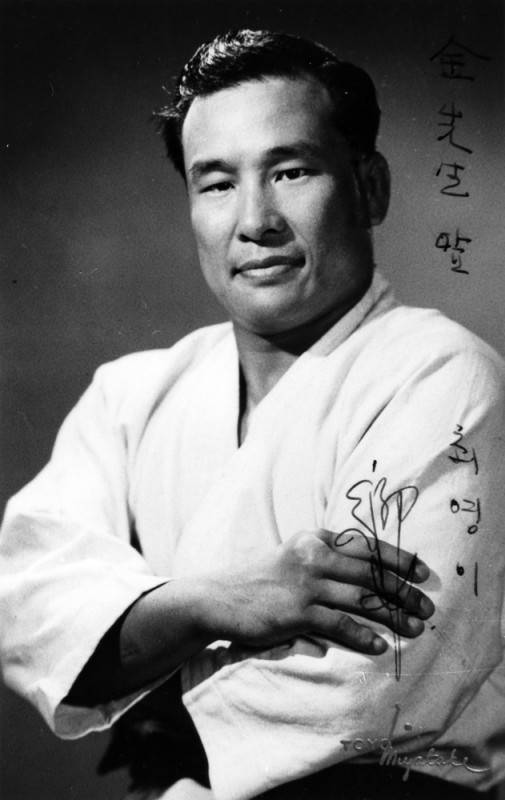
Born in 1923 in Japanese-occupied Korea, Choi Yeong-eui discovered martial arts at the age of nine with a Chinese Kempo teacher in Manchuria. At fifteen he left for Japan to train as an aviator and later adopted the name Oyama.
Confronted with racism and hardship, the young man developed an iron will. In Tokyo he practised judo and boxing before devoting himself to Okinawan karate.
The mountain retreat
Seeking mastery, Oyama withdrew alone into the mountains, first on Mount Minobu and later for eighteen months on Mount Kiyozumi. Relentless physical training, Zen meditation and study of the classics forged a body of steel and an indomitable will.
“A thousand days of training to forge the body, ten thousand days to polish the spirit.” This maxim captures the ascetic path from which he returned in 1950, aged twenty-seven.
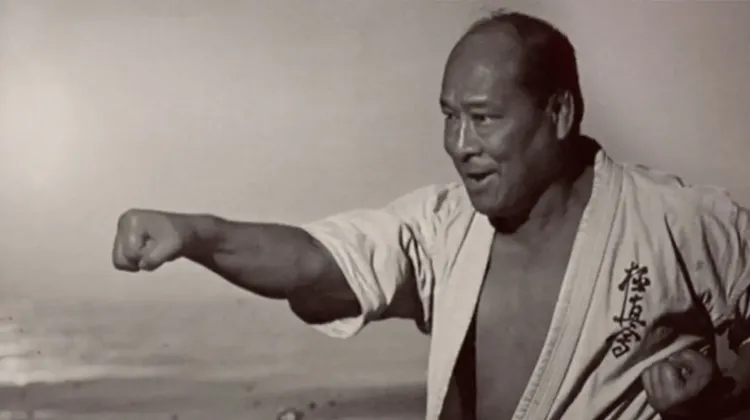
Mas Oyama in his early years, before the establishment of the Kyokushin.
The legendary battles
Back among the public, Oyama built his legend through real tests of strength. From 1950 onward, his demonstrations against bulls became symbols of karate's power.
During a 1957 demonstration in Mexico, he was badly injured and needed six months to recover. His conviction remained clear: karate must be tested through genuine confrontation.
The establishment of the Kyokushin
In 1953 Oyama opened his first dojo in Tokyo. His exceptionally demanding teaching attracted hundreds of students despite a high dropout rate. Kumite was practised full contact and without protective equipment.
As a synthesis of Gōjū-ryū, Shotokan and Korean and Chinese influences, his karate was officially named Kyokushinkai in 1964, with the founding of the International Karate Organization (IKO).
A global legacy
From the 1960s onward, Kyokushin spread across every continent. Oyama organised the first All-Japan Open in 1969 and the first World Open Tournament in 1975, firmly establishing full-contact karate on the international stage.
When he died in 1994, Mas Oyama left an art practised by millions and a philosophy of life embodied by the Osu spirit: endure everything, never give up.