IKO-1
1994Shokei Matsui
World Champion 1987, he declares himself successor and retains control of the Honbu Dojo in Tokyo. His organization presents itself as the direct continuation of the Kyokushinkaikan.
How one man's karate became a global movement and at the death of his founder split into several large families.
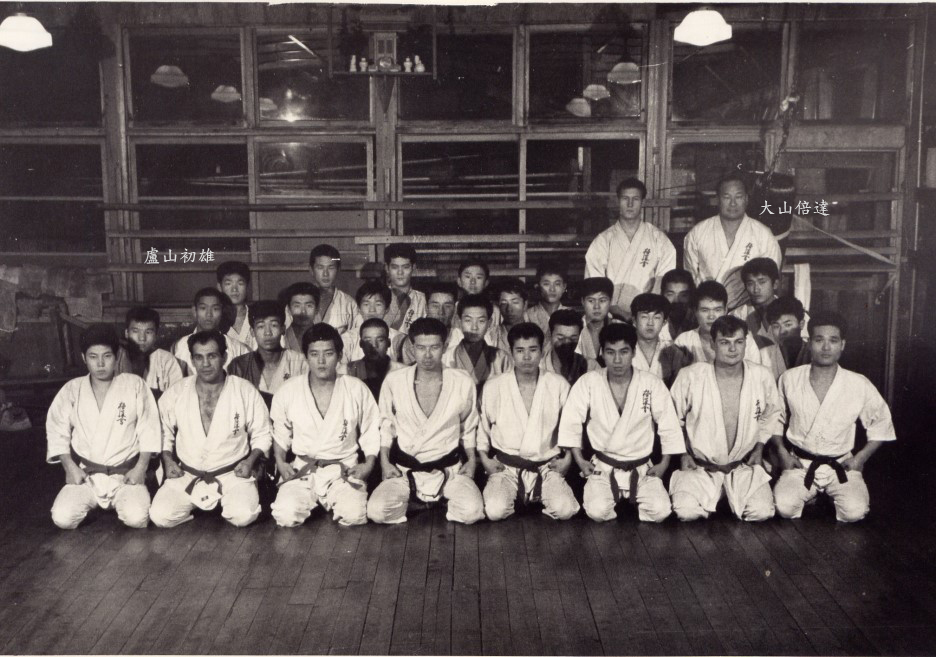
In 1964 structured around the International Karate Organization (IKO), the Kyokushinkaikan has an amazing growth under the authority of Mas Oyama, who remains the uniting figure of the whole movement.
On his death in 1994, without a clearly recognised successor, the IKO shall fall apart: Several high-graduates claim Sosai's legacy, leading to autonomous federations.
Shokei Matsui
World Champion 1987, he declares himself successor and retains control of the Honbu Dojo in Tokyo. His organization presents itself as the direct continuation of the Kyokushinkaikan.
Kenji Midori
In 2003, this branch was renamed WKO Shinkyokushinkai under Kenji Midori (World Champion 1991). This is the line of our club.
Yoshikazu Matsushima
Veteran of the first generation, he refuses the authority of Matsui and sets up his own international structure (formerly "IKO-3 ").
Hatsuo Royama
An iconic fighter of the 1970s, he left the IKO in 2002 to return to the source, emphasising tradition and the spiritual dimension of budo.
Steve Arneil
Already in 1991-92, before Oyama's death, this Western pioneer left the IKO and founded the International Federation of Karate, the first large independent Kyokushin organization.
The branch long known as IKO-2 found new momentum under Kenji Midori, the 1991 world champion. In 2003 it adopted the name WKO Shinkyokushinkai.
Shinkyokushin preserves Oyama's full-contact spirit while modernising its organisation, refereeing and sporting structure. Today it is one of the largest Kyokushin organisations in the world.
Our club belongs to this lineage through its affiliation with the Belgian federation BKOS.